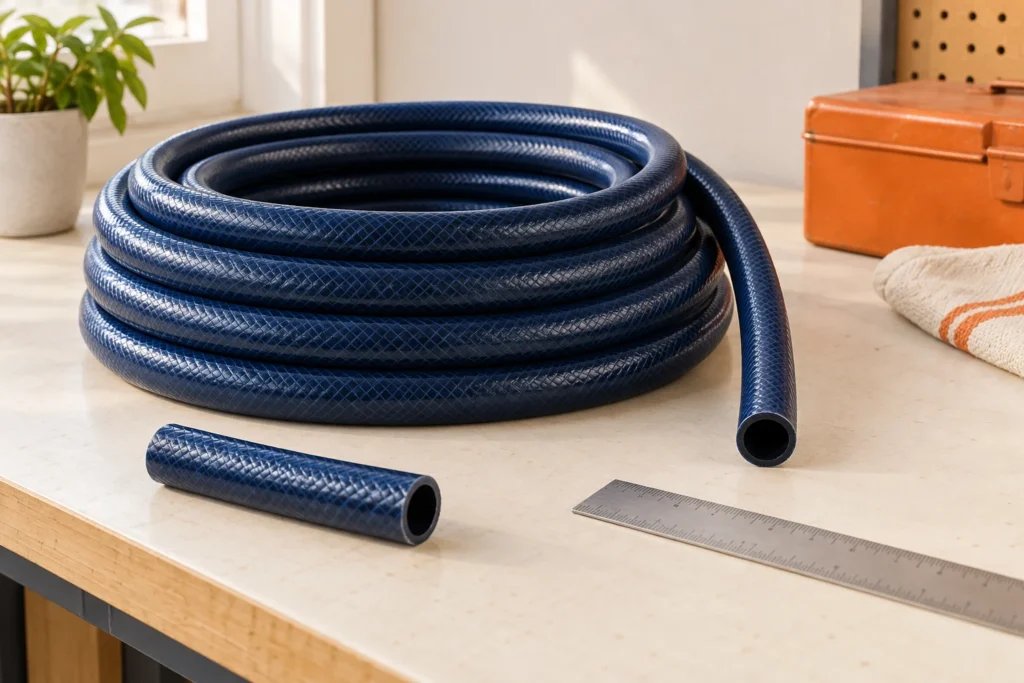
A photograph of a hose coil does not reveal whether it is suitable for a particular job. Two products with similar colours and dimensions can have different materials, reinforcement, pressure limits and permitted uses. A wholesale hose specification therefore needs to describe the application as well as the item being purchased.
This guide helps distributors and purchasing teams prepare an enquiry for flexible water hose and related general-purpose products. It explains the information to request before comparing offers. It is a purchasing checklist, not an installation design: the manufacturer or a qualified technical specialist should confirm suitability for the intended service.
Describe the application before choosing a model
Explain what will pass through the hose, where it will be used and how it will be handled. State whether the application is water delivery, irrigation or another specifically identified use. If the medium contains additives, describe them accurately rather than writing only “water”.
Tell the supplier whether the hose will remain fixed, be moved regularly, be dragged across surfaces or be stored on a reel. Include exposure to sunlight, weather, nearby heat and other relevant conditions. These details help the technical reviewer assess the whole operating environment.
Do not assume that a general-purpose hose is suitable for drinking water, food contact, fuel, gas, chemicals, compressed air or hydraulic service. Each application can require different evidence and product construction. A familiar appearance or a category label is not enough to establish those capabilities.
Specify internal diameter, length and tolerances
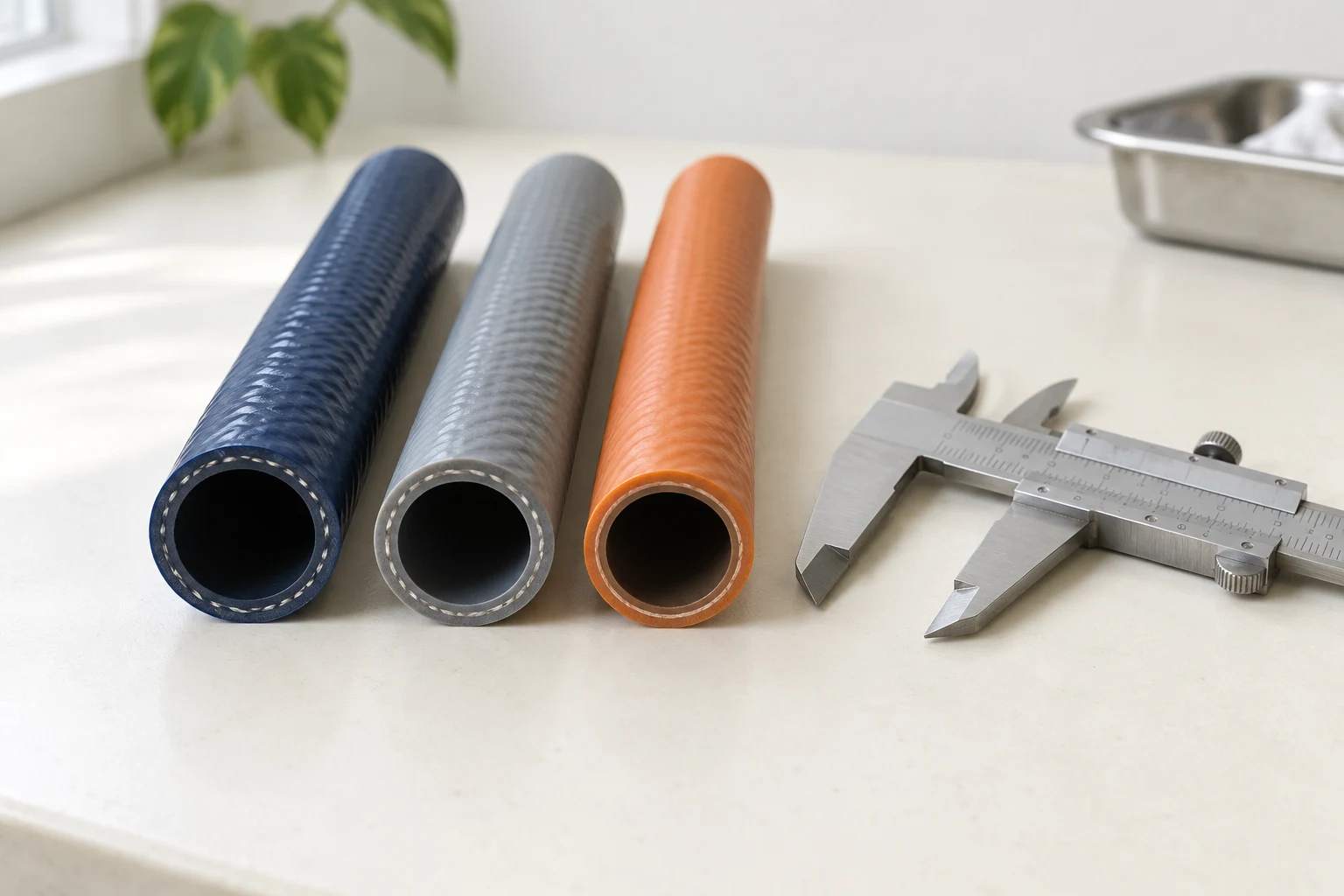
Identify the internal diameter needed for the application and clarify the unit of measure. Also request the outside diameter when fittings, clamps, reels or storage arrangements depend on it. Avoid treating a nominal size as an exact measured dimension without checking the manufacturer’s specification.
State the required length per coil and the total number of coils. A price per metre and a price per coil cannot be compared until the coil length is confirmed. Ask whether the supplied length is continuous and which length tolerance applies to the order.
Keep the measuring basis consistent
Use one unit system throughout the purchasing brief, with explicit conversions only when necessary. Record whether a dimension is nominal or measured and request the relevant tolerance. When an existing fitting must be matched, provide its technical details rather than relying on an informal measurement of the outside of the hose.
If you need several sizes, list each as a separate order line. Include its quantity, length and intended use. This prevents a supplier from quoting a single representative size when the actual requirement contains several different products.
Distinguish working pressure from burst pressure
Ask for the permitted working pressure at the stated operating temperature. A burst-pressure figure is not an operating limit and should not be used as one. Pressure variations and transient peaks may matter, so provide the actual system requirements to the technical reviewer.
The hose, fittings and assembled connection need to be considered together. A hose rating alone does not establish the capability of the complete assembly. Request the manufacturer’s guidance for compatible components and the intended connection arrangement.
If the service involves suction, identify that explicitly and request the relevant suitability information. A product intended for discharge may behave differently under vacuum. Do not infer suction capability from a thick wall or a reinforced appearance.
Confirm temperature and material compatibility
Provide the expected temperature of the medium and the surrounding environment. Include unusual operating or storage conditions that the product may encounter. Ask the supplier to confirm the limits for the specific hose and any effect temperature has on the permitted service conditions.
Request the material specification for the inner tube and other relevant layers. Product names and colour schemes do not establish material compatibility. If the medium or cleaning process includes chemicals, give the technical reviewer the exact substances and conditions needed for an assessment.
For a distributor, keep application claims in customer-facing material within the manufacturer’s documented scope. Do not expand a general water-hose description into a drinking-water or chemical-service claim without evidence for that exact product and intended use.
Review construction without relying on layer count
Ask about reinforcement, cover material and any construction details relevant to the intended duty. A larger number of layers is not, by itself, a complete measure of suitability. The material, design and verified performance of the finished product matter more than a simple marketing comparison.
Request information on flexibility, bend limitations and handling where those characteristics affect the application. A short sample can help assess feel and dimensions, but it cannot establish every operating characteristic. Keep practical observations separate from documented performance limits.
For retail distribution, appearance may still matter. Agree colour, surface finish, marking and presentation alongside the technical specification. Treat these as additional requirements rather than allowing a visually attractive sample to replace the engineering review.
Ask for evidence that matches the offered product
Request a current technical data sheet with an exact product code. If test reports are supplied, check what was tested, the method, the date and the identity of the sample. Confirm whether the report supports the particular characteristic you need to verify.
Where a standard or approval is claimed, ask for its scope and supporting documentation. Similar product names can cover different versions, so the evidence should identify the offered model or relevant product family clearly. Do not treat an unexplained logo on a brochure as sufficient proof.
Keep supplier answers in writing and attach them to the final specification. When a requirement remains unanswered, mark it as unresolved. It is better to request clarification than to convert a missing pressure or temperature limit into an assumption.
Plan samples and acceptance checks
Agree the purpose of the sample before it is sent. You may need to review dimensions, packaging, colour or handling, while technical qualification may require a separate test programme. Explain which checks your team will perform and which must be supported by the manufacturer.
Identify the sample and retain its reference with your approval notes. Ask how it relates to the commercial production run. If material, reinforcement or other important details change after approval, require notification and a review before accepting the substitution.
Do not improvise hazardous pressure tests in a warehouse or office. Any testing of an assembly should follow an appropriate procedure using suitable equipment and competent personnel. The purchasing team’s role is to agree the evidence and acceptance criteria, not to invent a test from a catalogue number.
Define coils, labels and transport packing
Confirm the length, weight and dimensions of each coil and how coils will be wrapped or boxed. Ask how product identity and batch information will remain visible during storage and distribution. If the order contains multiple sizes, request clear separation and labelling.
Review carton and pallet arrangements against the receiving warehouse’s handling needs. A tightly compressed pack may affect presentation, while an oversized pack may make transport inefficient. Ask the supplier to explain the proposed packing arrangement and provide photographs where useful.
Specify any barcode, label language or distributor reference required on the packaging. Approve artwork before production and ensure it does not make unsupported application claims. Keep the approved version with the order so repeat purchases can be checked against the same reference.
Build a comparable wholesale enquiry
Alami Trade’s construction materials catalogue includes several hose listings. Use the exact listing or product name to identify your starting point, then add the application details and technical questions that the category page cannot answer.
Ask each supplier to quote the same diameter, coil length, quantity and delivery scope. Request the currency, price unit, minimum order quantity, quotation validity and production readiness date. Confirm whether the price includes special labels, cartons, pallets or inspection arrangements.
A useful enquiry might describe a water-delivery application, identify the required dimensions and ask the supplier to confirm the appropriate working limits and compatible connections. It should not prescribe an unverified hose merely because a previous product looked similar. Submit your brief through Alami Trade’s wholesale contact page for product-specific clarification.
Check the shipment and preserve traceability
At arrival, compare product codes, sizes, coil counts and packing details with the order. Inspect visible condition for damage, deformation or other discrepancies and record findings before distributing the goods. Keep labels and batch references connected to your stock records.
For example, a shipment can have the correct total length but the wrong mix of coil sizes. Checking only the total quantity will not identify that problem. Receiving staff should compare each line item with the specification, including length per coil and number of coils.
Agree a reporting route for discrepancies before delivery. Preserve photographs, sample identifiers and relevant documents so the supplier can investigate. For repeat orders, reconfirm the approved specification and ask about changes rather than assuming that the same trade name always means the same product.
Frequently Asked Questions
Can I choose a hose from its colour or photograph?
No. Use the photograph to identify the listing, then review the material, dimensions, operating limits and intended application. Visual similarity does not establish equivalent performance.
Is burst pressure an acceptable working pressure?
No. Request the manufacturer’s permitted working pressure for the relevant conditions. Burst data describes a different characteristic and must not be substituted for an operating rating.
Does a water hose automatically suit drinking water?
No. Ask for evidence supporting the exact drinking-water application and destination requirements. General water service does not establish that suitability.
What is the most useful information for a first enquiry?
Provide the medium, application, dimensions, temperature and pressure requirements, quantity and destination. Ask the supplier to identify any missing information needed for a technical recommendation.
Conclusion
A complete wholesale hose specification links the intended service to documented product characteristics, compatible connections and clear acceptance criteria. Compare offers only after those details are aligned, and keep the approved specification connected to every shipment.